What a residential security officer writes in the 6am handover

What should your night security officer put in the morning handover?
Your night security officer should record the overnight facts that affect daytime control: incidents, unresolved risks and access concerns for the day officer, concierge or building manager. Good shift handover notes show what happened, what still needs attention and who has already been told.
Across Central London and wider Greater London residential buildings, the morning changeover is a busy point in the day. Residents start leaving, cleaners arrive, contractors book in and deliveries begin. Any loose end from the night shift quickly becomes a management problem.
Many buildings judge overnight cover by whether a security officer was visible. We look at the handover because it shows whether the service is organised enough to pass useful information forward. A neat uniform at reception tells you very little if the overnight security report leaves the day team guessing.
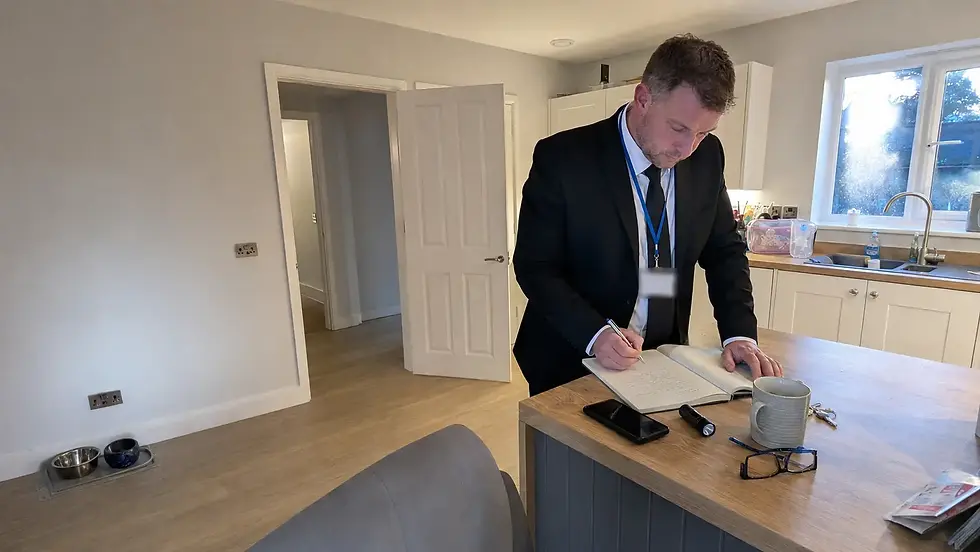
The 6am handover turns night activity into day control
In the minutes before a morning changeover, the night security officer needs to leave the day officer or building contact with clear priorities. A useful 6am handover turns overnight facts into daytime control, not a running diary of every minor observation. At Fahrenheit Security, we treat the handover as part of the service discipline on residential sites, linked to the site assignment instructions and the way the building actually runs.
A residential security handover will vary by site, because shift times and building arrangements differ. The useful content stays consistent: the handover should help someone act, check, escalate or follow up. The NPSA (National Protective Security Authority) Control Rooms Guidance gives a sound backbone here, with handover content covering dealt-with incidents, ongoing issues, contact changes, technical or site problems, unusual activity and the positions of security officers on duty where relevant.
For a London block, estate or high-value residence, we would expect the security handover report to cover these points in plain terms:
Incidents and unresolved issues. The entry should state what happened overnight, what action the officer took and what still needs attention. A resident complaint, alarm activation or access concern needs enough detail for the day contact to pick it up without replaying the whole shift.
Patrol findings. Patrol notes should point to anything that affects the site, such as an unlocked area, a maintenance defect or an unusual observation around an entrance. Routine “all in order” entries have their place, but the useful line is the one that changes what the day team checks.
Access, keys and contractors. Key control, contractor access and expected arrivals matter because they affect who is allowed into the building after the handover. If an overnight instruction changes, the day officer needs that update before the first arrival is at the desk.
Alarms, CCTV references and technical faults. Alarm activity, CCTV handover notes and equipment faults should be factual. The handover should say what was checked, what remains open and where a fuller record sits if the issue needs review.
Actions for the day contact. The strongest shift handover notes make the next action clear. That might be a building manager call, a maintenance follow-up or an escalation to the control contact.
Handover time also needs to be treated as working time in the planned shift, because outgoing and incoming security officers need space to exchange information properly. A changeover that happens in a rush at the desk is where small gaps start.
Routine handovers and incident reports serve separate purposes
Residential buildings often use more than one security record, and each one has a different job. The routine handover carries the shift forward, the daily occurrence book or site log records the wider timeline, and a separate incident report gives management the fuller account of a significant event.
The table below compares a routine handover, the daily occurrence book or site log, and a separate incident report.
A good security guard daily activity report does not try to carry every formal detail inside the handover line. The handover can point to the incident reference, the site log entry or the control room update, so the day team gets the right level of information quickly.
That distinction matters when a managing agent reviews service quality. One short handover entry can be useful at shift change, while the incident report carries the detail needed for later review.

Controlled details need clear boundaries
Your first concern is simple: who sees the handover? Residential security reporting has to give authorised people enough information to act, while keeping resident details, visitor records and security-sensitive notes inside controlled channels.
CCTV notes belong in controlled channels
CCTV references in a handover should be factual, limited and connected to an operational need. If a camera view helped check an access concern, the note can record that the footage was reviewed or that a reference exists. The handover should avoid casual descriptions, unnecessary personal detail and anything that turns the log into a resident-facing update.
The Information Commissioner’s Office treats CCTV and similar video surveillance as personal data processing when people can be identified, under UK GDPR and the Data Protection Act 2018. Its checklist for limited CCTV systems refers to visible signs, a defined controller, secure storage for a defined period and restricted access for authorised individuals. For our purposes, that points to a plain rule of judgement: CCTV notes belong with people who need them for building control.
Resident and visitor details need restraint
Visitor log security records, access records and resident complaint notes all carry information about people. A useful handover names the operational issue and the action needed, then keeps extra personal detail out unless it is needed for the job.
Consider a visitor who arrived late without the expected authorisation. The day contact needs to know that access was refused or checked, who was informed and whether a follow-up remains open. The handover does not need to become a broad account of the visitor’s private circumstances.
Discretion is part of professional residential security. Clear logs help the building run; controlled logs protect the people in it.
Good handovers reveal the quality of residential cover
One handover entry can tell you a lot about the whole service. If it is vague, late or full of filler, the issue is rarely just the wording. It points to weak briefing, poor supervision or a shift culture where the officer’s visible presence matters more than the building’s continuity.
A controlled handover gives you an operational record you can act on, not a notebook that only proves someone was present. At Fahrenheit Security, we use handover discipline as one of the ways we keep managed residential security coherent across shifts, especially where the building manager, concierge and control contact all rely on the same information.
Two approaches show up quickly. One approach puts a security officer on site and leaves the handover as a loose end at the end of the shift. The stronger approach treats the security shift handover as part of the cover itself, with priorities carried forward and sensitive details kept in the right place. For a residential building, the second approach gives you better control because the day starts with usable decisions, named actions and fewer hidden gaps.

Questions we get asked about residential security handovers
Should the handover be verbal as well as written?
Both work best together. The written entry is the record, and a short face-to-face exchange lets the incoming officer ask about anything unclear before the outgoing officer leaves. A written note alone can be misread. A verbal briefing alone leaves nothing to check later.
What happens if the incoming security officer queries an entry?
The query should be resolved through the outgoing officer, the control contact or the site manager, depending on the site procedure. If the point remains open, the query itself should be recorded so management can see what was checked.
Are photos, screenshots or attachments useful in a security shift report?
They can be useful only where the site procedure allows them and access stays controlled. Any image linked to CCTV, visitors or residents needs careful handling because it can contain personal or security-sensitive information.
Does a handwritten security log still have a place?
A handwritten security log can still work if entries are legible, dated, controlled and reviewed. Digital systems make searching and time records easier, but poor entries remain poor entries in any format.
Who corrects an error in the security log book?
An authorised person should correct the record in line with the site procedure, with the change made clearly and traceably. Quietly removing or rewriting entries creates confusion when the log is reviewed later.


Comments