Can one security officer really cover your shop? A reality check

Can one security officer really cover a shop?
Yes, one security officer can cover a shop when the layout is simple, footfall is manageable, stock risk is controlled and escalation support is clear. We do not treat visible presence as full cover, because one person cannot watch the door, floor, high-value stock and closed-circuit television at once.
A common mistake is to count a guard on the rota and assume the shop is covered. Real cover means the officer can observe, deter, respond, record what happened and escalate issues without leaving the main risk point exposed.
Contracted retail guarding also has a licensing point. GOV.UK guidance from the Security Industry Authority, known as the SIA, lists manned guarding as licensable work, and a contracted operative placed in a shop by a private security company needs the right licence where the work involves licensable activity. That does not decide how many officers you need, but it does set the baseline for professional retail security officer cover.
In a lower-risk store, one guard retail security can work well. In a busy flagship store, a shop with several entrances, or a store with high-value stock spread across different areas, one officer may spend the day choosing which gap to leave open. That choice should come from a proper assessment of your trading conditions.

One officer can work where the shop is simple enough
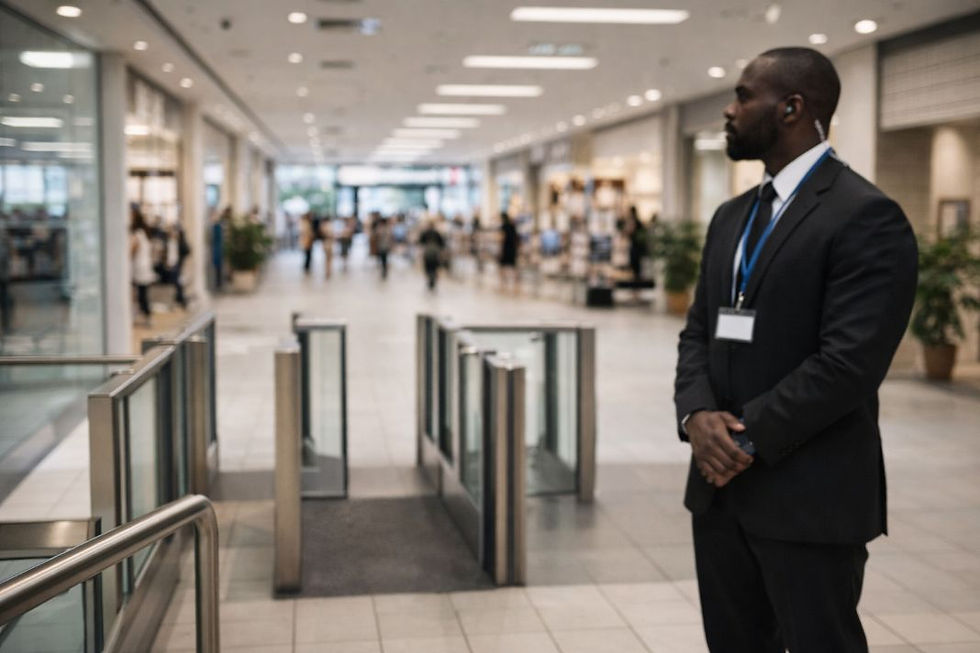
A compact shop with one entrance, clear sightlines and steady customer flow is the strongest case for one officer. The officer can hold a visible door position, move through the sales floor at sensible points and stay close enough to colleagues to support an incident.
Size matters less than movement. A small store with blind corners and fast peaks can be harder to cover than a larger store with a clean layout. In Central London retail, peak trading periods, street-facing entrances and premium brand expectations all change the answer, because the officer must protect the customer experience as well as the stock.
At Fahrenheit Security, we look at the store before we judge the number of officers. We want to know where customers enter, where high-value items sit, where colleagues need support and how the officer calls for help. If one officer is working without close supervision, the Health and Safety Executive, known as the HSE, treats security guards as a clear example of lone workers, so the risk needs managing before the shift starts.
Closed-circuit television, or CCTV, can support that plan, but it cannot put the officer in two places. Good one-person cover has a clear position, a clear escalation route and enough management oversight to stop the role drifting into whatever task shouts loudest that day.
Warning signs show when one officer is stretched too far
One officer becomes stretched when the shop asks for door control, floor walking, high-value stock protection and incident response at the same time. The problem is practical: the officer cannot hold the entrance and deal with a confrontation at the back of the store without something going uncovered.
Retail crime is a stock loss issue, and it is also a safety issue. The British Retail Consortium Retail Crime Survey 2025 reported over 2,000 incidents of violence and abuse every day in retail, and it also linked theft and violence, with confronting thieves named as a major trigger. That matters because a one-officer plan judged only on theft volume misses the point where a shop security guard coverage decision becomes a safety and response decision.
Premium stores face another layer of judgement. A security officer who is too fixed at the door may look visible but miss what happens deeper in the store. An officer who patrols constantly may lose entrance control. When a store has repeat incidents, high-value exposure or aggressive behaviour, two officers may add safer response and better incident reporting, while also adding another uniform.

Door, floor and CCTV duties need a planned priority
Where should the officer stand? The answer changes through the trading day, and we set that priority before the shift instead of letting habit decide it.
Identify the highest-risk position. At some times that position is the entrance. At others it is a stock area, a queue point or a part of the floor where colleagues need visible support.
Check what becomes uncovered when the officer moves. If the officer leaves the door to support an incident, someone else needs to know what to watch and how to raise the issue.
Match the position to trading peaks. A static door post can deter casual theft during busy entry periods, but it may reduce awareness deeper inside the store.
Use CCTV and colleagues as support, not a substitute. CCTV helps with observation and evidence notes, but a screen does not speak to a customer, reassure colleagues or respond on the floor.
Review incident reports and adjust the deployment. Repeated notes from the same area tell you where the real pressure sits.
Clear instructions also stop the officer being pulled into low-value tasks that weaken cover. If the brief is vague, the officer ends up solving immediate problems and the planned security position gets lost.
Long-term retail guarding works better when risk leads the plan
Some retailers start with the cheapest fixed answer: one officer, the same position, the same hours, every trading day. That can look efficient on paper, especially when the immediate aim is to control cost, but a flat plan struggles when risk changes across late trading, launches, busy weekends or a run of incidents.
A better model starts with the shop itself. One officer may still be the right answer, but the decision comes from layout, trading pattern, stock profile, colleague support and the route for escalation. Fahrenheit Security works from that kind of operational reality, because retail guarding in Central London rarely fits a simple headcount formula.
Compliance, licensing and lone working risk should sit inside the management of the service, without becoming your daily burden. The useful difference is between buying a guard as a fixed presence and running security cover as a managed part of the store operation. The second approach gives you fewer blind spots and better control over time.

Questions retailers ask us about one-officer shop security
Does a contracted shop security officer need an SIA licence?
A contracted security operative supplied by a private security company needs the right SIA licence where the work involves licensable guarding activity. In-house arrangements can be different, so contracted retail guarding should be checked on its own terms.
Is CCTV enough without a security officer?
CCTV supports observation, evidence and review, but it does not replace a trained person on the shop floor. A camera cannot manage a confrontation, support colleagues or provide customer-facing reassurance.
Can one officer deal with shoplifting and aggression at the same time?
One officer can respond to one live priority, but they cannot cover every risk point during an incident. Where theft and aggression are linked, the escalation plan matters as much as the officer’s starting position.
Does a luxury or flagship store need a different guarding plan?
A premium store may need security that is visible, discreet and customer-facing at the same time. The plan should reflect the store layout, stock exposure and brand expectations, not just the number of doors.
How often should retail security cover be reviewed?
Security cover should be reviewed whenever the risk pattern changes, such as after repeated incidents, layout changes, new trading hours or a different stock profile. Incident reports give the clearest starting point for that review.
This is general information, not professional advice.


Comments