Why do some retail security officers just stand there and do nothing?

Why do retail security officers sometimes appear to do nothing?
Retail security officers often appear inactive because much of their job is based on deterrence, observation, and controlled decision-making. In many shops and shopping centres, standing in the right place, watching carefully, and following security protocols can prevent incidents before any visible action is needed.
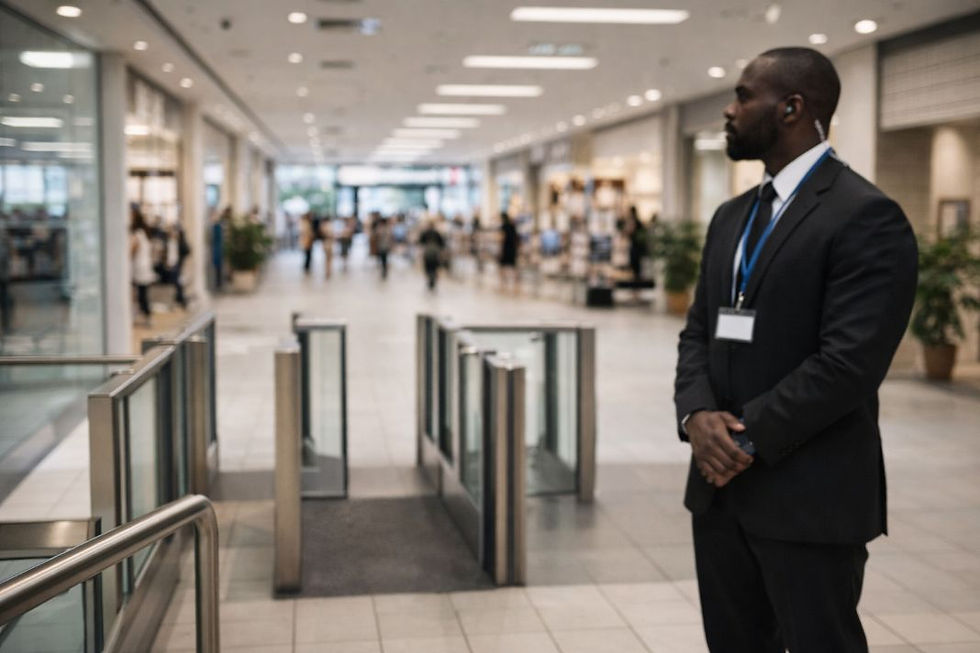
A uniformed officer near an entrance can change behaviour across the whole shop floor. Customers usually feel reassured, store teams often feel supported, and anyone considering theft may think twice. From a distance, that can look like passive guarding. In practice, it is often the first layer of retail security.
Visible presence works because retail deterrent measures are often psychological before they become physical. An officer who remains calm, alert, and easy to spot sends a message that the site is being watched and that loss prevention is active. Many incidents never begin because that message lands early.
Several common assumptions get this wrong:
Standing still means the officer is disengaged
Action always has to be visible to be effective
A quiet shift means the officer has done very little
Observation is less useful than intervention
Retail environments rely heavily on this kind of visible security. In other words, what looks like doing nothing may actually be the job working as intended.
Operational protocols often require observation first
Security officers do not usually act on impulse. Most retail security policy frameworks set out when to observe, when to report, and when to intervene. Those rules exist to protect customers, shop teams, property, and the officer on duty.
A typical decision process looks something like this:
Observe the behaviour and assess whether it is suspicious or simply unusual.
Monitor the situation without escalating it too early.
Inform store management or relevant colleagues if concern increases.
Follow the agreed escalation process if a threshold for action is reached.
Record the incident in line with reporting requirements.
That sequence can create a gap between what the public sees and what the officer is actually doing. Someone watching from the till point may think nothing is happening, even though the officer is tracking movement, noting patterns, and waiting for the right moment under site rules.
Liability also shapes intervention rules. An officer who steps in too early, uses the wrong approach, or misreads a situation can create risk for everyone involved. Observation duties are therefore part of professional compliance, not a sign of hesitation. Fahrenheit Security operates in environments where that balance matters, particularly in client-facing locations where judgement and restraint need to sit side by side.
Training and professional judgement shape the response
Imagine a customer moving quickly between aisles, picking up items, putting them back, and glancing around often. One person may read that as obvious shoplifting. A trained officer may see several possible explanations and wait for more reliable indicators before acting.
Situational awareness sits at the centre of security training. Officers are taught to scan behaviour, surroundings, exits, staff activity, and public risk at the same time. That kind of threat evaluation is quiet work, but it is still active work.
Premature intervention can make a simple misunderstanding much worse. A rushed approach may embarrass an innocent customer, create conflict on the shop floor, or distract attention from a genuine issue elsewhere in the store. Good risk assessment therefore depends on patience as much as presence.
Conflict management also plays a part. Many officers are expected to lower tension, not raise it. A calm stance, careful observation, and measured timing often produce a better outcome than stepping in at the first hint of suspicion. Professional judgement is visible less in dramatic moments and more in the number of situations that never spill into public disorder.

Security has to protect the shop without unsettling the customer
Most shoppers want to feel safe, but few want to feel watched too closely. That creates a delicate balance in retail environments, especially in premium stores, busy shopping centres, and customer-facing spaces where atmosphere matters.
An officer who intervenes too openly can change the mood of a shop in seconds. Nearby customers may become uneasy, queues may slow, and staff may lose focus. Store management often wants security and hospitality to work together, which means that discreet security can be more suitable than overt action in many everyday situations.
Consider the difference between two approaches. In one, an officer shadows a person aggressively across the floor and confronts them in view of others. In the other, the officer stays visible, keeps distance, alerts management quietly, and continues to observe. The second option often protects customer comfort more effectively, especially if the concern turns out to be unfounded.
That is one reason some officers seem reserved in public-facing areas. Their role can include supporting brand standards as well as security and hospitality, which calls for restraint, awareness, and a steady presence.
Practical limits also affect what an officer can do
Retail security roles come with boundaries. Some of those limits are contractual, some are operational, and some are simply practical.
Key constraints often include:
One officer covering a wide entrance, multiple exits, or several floors
Agreed duties that focus on deterrence, observation, and reporting
Limited authority compared with law enforcement
Competing priorities during busy trading periods
Response delays if support is off site or tied up elsewhere
A single officer cannot be in the stockroom, at the front door, and on the shop floor at the same time. Coverage limitations matter, particularly in larger stores or mixed-use sites where security deployment has to be spread carefully. What looks like inaction from one angle may actually reflect attention being directed to another area.
Role boundaries matter too. Security officers are not police officers, and retail contracts do not always permit the same range of actions people assume they can take. Store management may expect incident reporting, visible patrols, and support for safety procedures, but direct enforcement powers remain limited. That distinction often explains more than public frustration does.

Technology changes what visible officers are doing
Modern retail security rarely depends on one person standing alone. CCTV, alarm systems, radios, access controls, and remote monitoring can all shape how officers work on site.
Technology handles some tasks better than a person can. Cameras can hold a continuous view, recorded footage can support incident logs, and alarms can flag activity in restricted areas. Human officers, by contrast, read tone, body language, crowd mood, and context in a way systems cannot fully match.
Remote support can also alter expectations. An officer near the entrance may already have information from CCTV monitoring or from colleagues watching another part of the site. Equally, the officer may be staying in position because the agreed intervention trigger has not yet been met. Seen from the outside, that still looks like non-intervention.
The strongest setups treat people and systems as parts of one security picture. Surveillance can extend coverage, but it does not replace on-the-ground judgement in a busy retail setting.
Rethinking what “doing nothing” really means
The phrase itself is usually the problem. It flattens a professional role into whatever happens to be visible for a few seconds.
Public perception often misses the unseen parts of retail security:
watching patterns of behaviour
keeping an exit or payment area under view
waiting for confirmation before escalating
recording details for incident reporting
maintaining a calm environment through presence alone
Seen in that light, officer inactivity is often a misunderstanding. The officer may be preventing trouble, protecting the customer experience, or following security protocols that call for observation before action.
Retail security is likely to remain more subtle than many people expect. As shops continue to balance loss prevention, public comfort, and technology-led support, the most effective officer will not always be the one making the biggest scene. Quite often, the strongest performance is the one most people barely notice.


Comments