What happens to retail theft in London when tourist season starts?

Does retail theft in London change when tourist season begins?
Yes. As visitor numbers rise in major shopping areas, retail theft often becomes harder to spot and more varied in method. Busy stores, dense footfall, distraction, and faster customer movement can create conditions in which opportunistic theft is easier to attempt, especially in places such as Oxford Street and Regent Street.
By early afternoon in peak season, central London shopping streets can feel packed from kerb to counter. Queues grow longer, store entrances stay busy, and attention is pulled in several directions at once. In that setting, retail theft does not become inevitable, but the environment can shift in favour of anyone looking to exploit confusion.
A rise in visitors does not mean visitors themselves are the sole source of offending. That assumption is too simple and often unhelpful. Seasonal crime patterns are shaped by crowd density, temporary distraction, stretched supervision, and the fact that busy public areas can make suspicious behaviour less obvious.
London retailers, retail associations, local authorities, and the Metropolitan Police all work within that wider picture. Tourist season crime tends to be linked less to one type of person and more to one type of opportunity. A full shop floor, multiple payment points, open displays, and fast-moving crowds can mask concealment, tag removal attempts, or coordinated distraction near exits.
Crowd dynamics matter here. Someone asking for help, blocking an aisle, or creating a minor disturbance can divert attention for a few seconds, and in retail security those seconds can be enough to matter.

How retail theft patterns shift during tourist season
The main change is not always a simple jump in volume. Timing, location, and method can all shift once visitor traffic builds across central London.
Peak trading hours become more difficult to manage because legitimate customer activity and suspicious behaviour can look similar at first glance. A person lingering near premium stock may be browsing. A small group moving between displays may be shopping together. Security teams often have to make quicker decisions with less certainty.
Common seasonal changes include:
More distraction-led attempts near entrances, tills, fitting rooms, and promotional displays
Greater use of pairs or groups, especially where one person occupies attention and another targets stock
Higher pressure on stores near transport hubs, destination shopping streets, and major attractions
Luxury and flagship stores face one set of pressures, while high street retailers face another. Premium retailers may see more focus on compact, high-value items such as accessories, cosmetics, or branded goods that are easier to conceal and resell. Broad-format stores with heavy footfall may deal with faster grab-and-go behaviour, bag theft, and stock loss that is only noticed later during floor checks.
Across a typical summer week, patterns can change by time of day. Mornings may bring organised browsing and lighter pressure on exits. Midday and late afternoon can produce denser footfall, longer queues, and more noise, which makes active monitoring harder. Evening trade near restaurants, theatres, and transport links can add another layer, especially when shoppers, commuters, and visitors all mix in the same spaces.
Pickpocketing and bag theft also sit close to this picture, even though they are not identical to shoplifting. In packed retail areas, the same crowd conditions that affect stores can affect customers too, which means that tourist area security often has to look beyond shelves and stock alone.

How retailers and security teams respond
Retailers do not wait for peak season to start before adjusting their approach. Strong preparation usually begins with reviewing store layout, pressure points, and trading patterns from previous busy periods.
Visible deterrence remains one of the most immediate responses. Extra patrols near entrances, escalators, high-value displays, and exit routes can alter behaviour before an offence develops. Security officers in customer-facing roles often balance observation with polite engagement, because a brief presence on the shop floor can interrupt the anonymity that theft often relies on.
Loss prevention tactics also become more focused. A retail team may move vulnerable stock, revise fitting room checks, tighten receipt verification at selected exits, or increase floor-walking during known peak windows. None of those measures works in isolation, yet together they can reduce blind spots.
Training matters just as much as headcount. In high-footfall settings, retail management often needs sales teams and security operatives to recognise distraction techniques, group movement patterns, and signs of concealment without creating unnecessary friction for genuine shoppers. Calm communication is part of that skill set.
Coordination outside the store can be just as important. In central London, shops may share information through local business networks, crime prevention units, or area partnerships. The Metropolitan Police and local authorities can also shape how incidents are reported and escalated during busier periods.
A practical response often includes:
Repositioning security officers to match crowd flow rather than fixed assumptions
Briefing teams before busy trading windows on current methods and hotspot areas
Reviewing incidents quickly so patterns can be spotted within days, not weeks
For firms such as Fahrenheit Security, the operational challenge is often less about adding a uniformed presence everywhere and more about placing the right security officers in the right part of the store at the right moment.
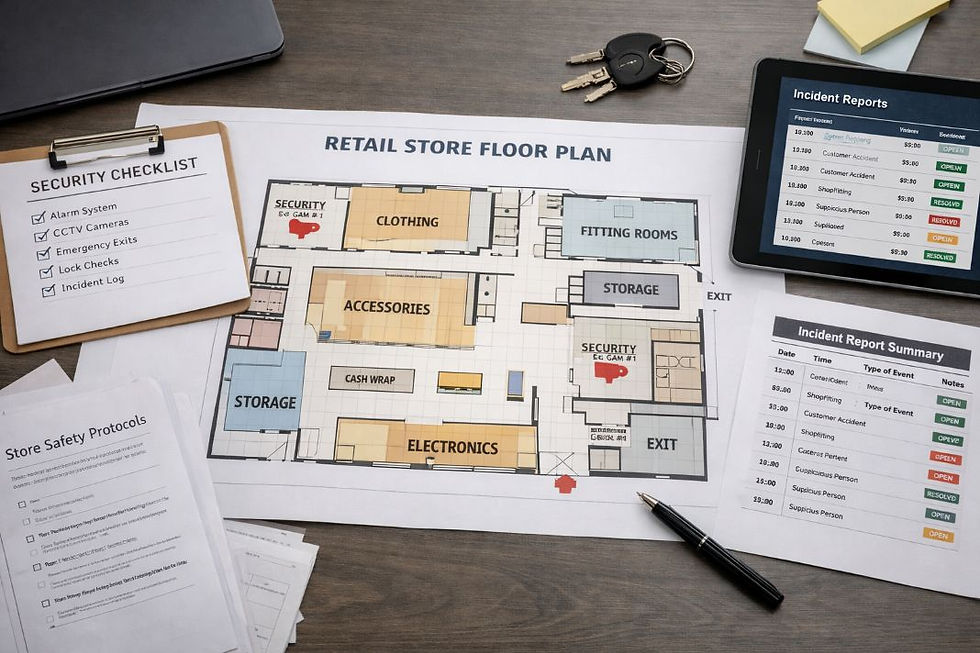
The role of technology in detecting and preventing theft
Technology gives retailers more visibility during periods when human attention is under strain. It works best as support for trained judgement, not as a replacement for it.
CCTV remains central in many shops, especially where entrances, self-service areas, and premium displays need continuous oversight. Live monitoring can help identify repeated movement patterns, suspicious regrouping, or attempted concealment that may be missed on the floor. Recorded footage also supports incident reporting and evidence collection after the event.
Electronic article surveillance systems are another familiar layer. Tagged goods, alarm pedestals, and exit alerts do not stop every offence, although they can increase the chance of interruption at the point of departure. Their value is usually strongest where tagging is consistent and responses are clear.
Some retailers also use data to assess risk more accurately. Incident reports, shrink patterns, peak footfall times, and known theft locations inside the store can all inform deployment decisions. If one entrance produces repeated issues during late afternoon, that pattern may justify a different patrol route or stronger coverage near adjacent displays.
Remote monitoring and digital reporting tools add speed. A suspicious sequence seen on camera can be relayed to floor teams in real time. An incident logged properly on the same day is far more useful than a vague note added later from memory. Even so, a camera cannot read intent on its own, and an alarm cannot judge context, which is why human oversight still sits at the centre of effective theft detection.
Challenges unique to London's retail environment
London brings together density, variety, and movement on a scale few UK retail locations have to manage. Tourist season amplifies those pressures instead of creating them from scratch.
Oxford Street, Regent Street, Covent Garden, Knightsbridge, and other major destinations draw a mix of tourists, local shoppers, office workers, and evening visitors within the same trading day. That blend affects crowd flow, queue behaviour, and the way people enter and leave stores. A retailer may face a lunchtime office rush, an afternoon tourist wave, and an evening leisure crowd without changing address.
Transport links shape the risk picture as well. Proximity to Tube stations, bus routes, and busy junctions can make fast arrival and fast departure easier. In practical terms, city centre theft is often tied to how quickly someone can blend into surrounding movement once outside.
Public events can complicate matters further. Seasonal promotions, parades, protests, sporting fixtures, and school holidays may alter footfall in ways that are hard to predict from one week to the next. London Business Improvement Districts, retail property managers, and Transport for London all influence the wider environment in which stores operate, even if theft prevention remains the retailer's direct responsibility.
Store design also creates tension. Flagship locations often want open, welcoming layouts with accessible displays and strong visual merchandising. Those same features can leave fewer barriers between product and exit. In London, where presentation and customer experience carry real commercial weight, security measures often have to be visible enough to deter and discreet enough to preserve the shopping atmosphere. That balance is especially delicate in luxury settings, where service standards and risk exposure sit side by side.

Legal and regulatory considerations during tourist season
The legal framework does not change simply because the streets are busier. Shoplifting still falls within the wider law on theft, including the Theft Act 1968, and retailers still need sound reporting and evidence practices if an incident is to be dealt with properly.
What can change is operational pressure around enforcement. During busy periods, police resources may be directed across a wider mix of demands in central London, including public order, crowd management, and transport-related issues. That does not remove the need to report offences, but it can affect response times and priorities on the ground.
Retailers therefore need clear internal procedures. Security officers and management teams usually need to record what happened, preserve relevant CCTV, note timings, identify stock involved, and document witness accounts where appropriate. Good evidence is practical, specific, and timely.
Key legal and procedural points include:
Theft allegations need factual reporting rather than assumption or exaggeration
CCTV and incident records are most useful when they are preserved promptly
Police response and prosecution decisions sit outside the retailer's control
Public order initiatives and local policing plans can also influence how visible enforcement feels in major shopping districts. Some areas may see stronger uniformed presence during peak visitor periods, especially where crowd management and retail crime overlap. Retail trade bodies often push for better coordination and clearer enforcement, though individual outcomes still vary case by case.
For shop floors and security teams, the legal lesson is straightforward. Accurate observation, proportionate action, and proper records matter far more than dramatic confrontation.

Looking ahead: rethinking retail security for a changing London
Tourist season has become a useful stress test for London retail security. It exposes weak points quickly, whether those weaknesses sit in staffing levels, floor layout, reporting discipline, or communication between teams.
Future planning is likely to depend on adaptability more than fixed templates. Visitor patterns can shift with school holidays, transport changes, major events, and broader economic conditions. A response plan that suited last summer may need revision for the next peak period, even in the same postcode.
Partnership will remain important. Retailers, security providers, local authorities, business forums, and police all see different parts of the same problem. Shared situational awareness can be more valuable than any single headline measure, especially in districts where criminal behaviour moves from one premises to another over the course of a day.
Fahrenheit Security operates in that practical space where customer-facing professionalism and active deterrence need to work together. Across London, that combination is likely to matter more as stores seek security models that fit busy, high-visibility environments without turning the shop floor into a fortress.
Retail theft in tourist season is best viewed as a moving pattern, not a fixed summer spike. The shops that cope best are usually the ones that treat busy periods as operationally distinct, read the crowd well, and adjust before the pressure becomes visible from the till queue to the street outside.


Comments