How to tell if your office building actually needs a security guard or just better access control

Does your office building need a security guard, better access control, or both?
An office building needs a security guard when the main risk involves real-time judgement, visible deterrence, incident handling, or hands-on visitor management. Better access control may be enough where risks are lower, entry patterns are predictable, and electronic systems can reliably control who comes in, when, and where they go. Many buildings sit somewhere in the middle, which is why the right answer usually starts with risk, layout, and daily use rather than habit or assumption.

Understanding the difference
A front door can be locked, but a locked door does not interpret behaviour. That simple distinction explains much of the security guard vs access control debate for office buildings.
Security guards bring physical presence, observation, and response capability. Access control systems manage entry through credentials such as cards, fobs, mobile passes, intercoms, or biometric checks. One is human judgement in real time. The other is controlled entry management through technology.
Here is the clearest way to separate the two:
Security guards are strongest at deterrence, visitor interaction, incident response, conflict management, and spotting unusual behaviour.
Access control systems are strongest at controlling entry points, recording access events, restricting movement, and supporting consistent building entry rules.
Manned guarding can adapt to situations that were not predicted in advance.
Electronic access works best where rules can be set clearly and followed consistently.
Office management and building owners sometimes assume that one replaces the other entirely. In practice, they solve different problems. An access system can stop an unauthorised card from opening a door, yet it cannot escort a disruptive visitor out of reception. A security officer can challenge tailgating at the entrance, whereas a door reader may log the authorised person but miss the extra person who slipped through behind them.
Visible security also affects behaviour. Some people feel reassured by a professional security officer in reception, especially in a busy multi-tenant building. Others may prefer a lighter-touch setup with good electronic entry systems and discreet monitoring if the site is low risk and staff know each other well.

Assessing your office building’s actual security risks
Before choosing office security options, it helps to look at how the building actually operates on an ordinary day. A seven-floor office in a shared city block has a different risk profile from a single-tenant headquarters with one manned reception and limited public access.
Risk assessment for offices should focus on what is valuable, who needs access, and where control can break down. That includes people, equipment, data, deliveries, shared spaces, and the moments when nobody is actively watching an entrance.
Common risk factors include:
Shared front entrances with other tenants or retail units
Frequent visitors, contractors, and couriers
High turnover of temporary passes or credentials
Sensitive departments, executive floors, or server rooms
Early starts, late finishes, or weekend occupancy
Previous issues with unauthorised access, theft, or disorder
Public-facing receptions that are open for long periods
Poor sightlines at entrances, lifts, loading bays, or side doors
Location matters as well. A central business district office may face higher footfall, more delivery traffic, and more unknown visitors than a smaller suburban site. Building vulnerability can also increase if reception is lightly staffed, if tenants share facilities, or if access rules differ from floor to floor.
Another point often missed is the delivery route. Parcels, food couriers, maintenance teams, and ad hoc visitors can create a steady stream of exceptions to normal entry procedures. Once exceptions become routine, control tends to weaken. That pattern appears in many offices long before anyone labels it a security problem.
Insurance requirements, internal policies, and landlord obligations may also shape what is reasonable. Property management teams should review these practical constraints alongside incident history, because the right system on paper can still fail in a building with loose day-to-day habits.

When a security guard is the right solution
Some situations point clearly to manned guarding needs. If a building depends on judgement, intervention, and calm authority, a security officer is often the right answer.
The reception area is busy, public-facing, or difficult to supervise with technology alone.
Unauthorised access attempts, tailgating, or confrontations have already occurred.
The building hosts senior executives, sensitive operations, or valuable assets that raise the consequences of a breach.
Occupancy extends beyond standard office hours, especially where fewer people are present.
Visitors need screening, escorting, or active management on arrival.
The site requires immediate incident response, including de-escalation and emergency support.
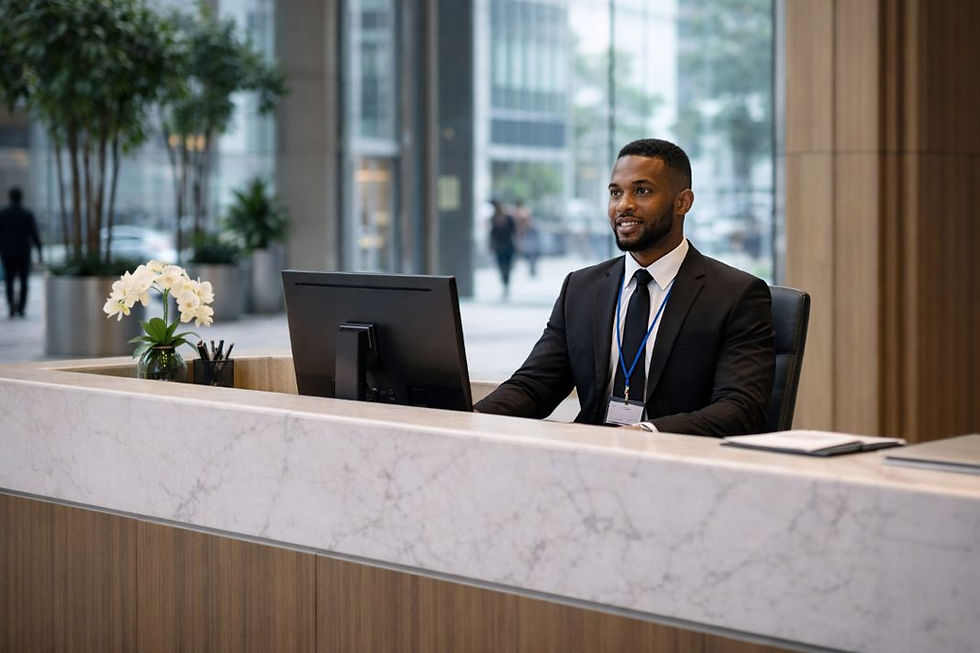
A professional security officer does more than stand near the entrance. In practice, that role may include greeting visitors, checking identification, monitoring circulation in the lobby, responding to alarm activations, liaising with building management, and managing situations that do not fit a fixed rule. That matters in offices where the issue is not simply entry permission, but behaviour once someone is inside.
Staff reassurance can be part of the equation too. After an incident, even a relatively minor one, people often feel the difference between a monitored door and a capable person on site. In a client-facing office, presence and professionalism can also support the tone of reception, which means that security becomes part of the building experience as well as its protective measures.
Fahrenheit Security works in corporate environments settings where presentation and response both matter, particularly in environments where visitors, tenants, and operational risk meet at the same front desk.

When better access control is enough
Some offices do not need a guard posted on site. If the building has stable occupancy, low public traffic, and clear access rules, electronic entry systems may provide the right level of control without manned guarding.
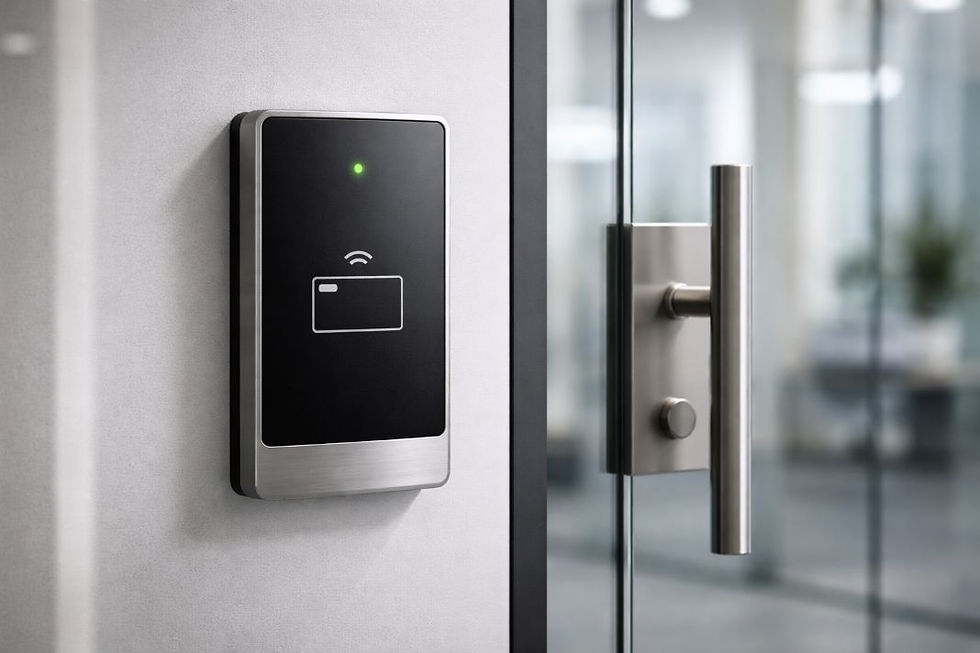
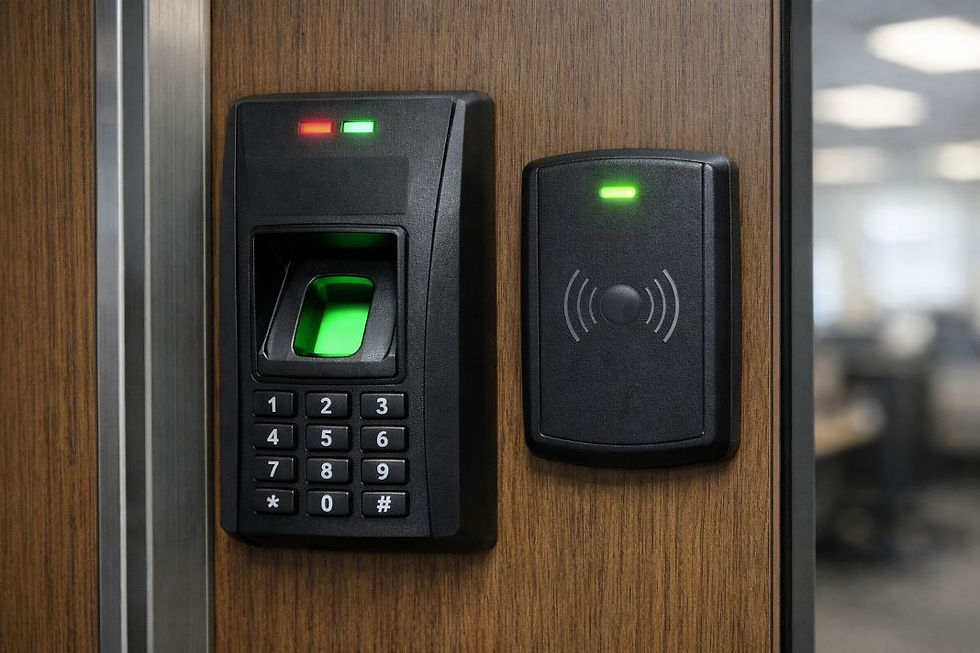
Access control for offices is often enough where a site has one main entrance, known users, limited visitor flow, and a culture of compliance. Key cards, mobile credentials, intercom entry, lift permissions, and timed door schedules can work well when they are set up properly and reviewed regularly.
Suitable signs include:
Staff and approved visitors are easy to identify
Reception demand is modest and predictable
Entry points are limited and physically secure
User permissions can be managed accurately by facilities management or IT departments
Audit trails and entry logs are useful for oversight
Remote monitoring supports the system outside core hours
A well-run setup can also separate access by floor, department, or room. That can be particularly effective in offices with restricted archives, finance areas, or comms rooms where only a defined group should enter. Good credential management matters here, because old cards, shared fobs, and delayed deactivation can undermine even strong building access solutions.
Technology still has limits. A system can record a door opening at 08:17, but it cannot judge whether someone looked distressed, agitated, intoxicated, or intent on causing disruption. Access control providers and security integrators can improve coverage and reporting, yet no electronic entry system removes the need for people to follow procedures carefully.
Hybrid approaches: combining guards and access control
Many office buildings do best with layered security. A hybrid model combines guards and access control so each covers the gaps left by the other.
Picture a multi-tenant office in Central London. Staff enter through card-controlled turnstiles. Visitors use an intercom or pre-registration system. A security officer remains in reception during the busiest part of the day, manages exceptions, challenges tailgating, and responds if a situation starts to drift. After hours, the building relies more heavily on electronic access, alarms, and remote monitoring. That is an integrated office security approach in practical terms.
The split often looks like this:
What access control handles
Access control manages routine entry, time-based permissions, floor restrictions, credential records, and entry logs. It gives building managers structure and consistency, especially where large numbers of authorised users move through the site every day.
What a security officer handles
A security officer deals with people, uncertainty, and immediate decisions. That may include visitor queries, suspicious behaviour, welfare concerns, emergency support, or escalation where someone refuses to comply with site rules.
This layered security approach can also be cost-aware. Some buildings need a full-time front-of-house presence. Others need a security officer only at opening and closing times, during peak visitor hours, or after a recent change in risk. The point is not to add measures for the sake of it, but to match protection to the building's actual pressure points.
Key questions to guide your decision
A sensible office security evaluation starts with a few direct questions. The aim is to test the building against daily reality, not against an idealised policy document.
Who enters the building each day, and how many of those people are unknown in advance?
Where are the points at which unauthorised access is most likely, including reception, lifts, side entrances, and loading areas?
What would cause the greatest disruption: theft, disorder, trespass, data exposure, or a failure to respond quickly to an incident?
Do current building entry systems stop unauthorised access reliably, or do they simply record it after the event?
How often do exceptions occur, including forgotten passes, unexpected visitors, contractor arrivals, and delivery issues?
Are staff expected to manage difficult situations themselves, even though that is not their role?
Does the building need visible reassurance and real-time response, or mainly better control over credentials and movement?
Has the site changed recently through new tenants, flexible working patterns, refurbishments, or altered opening hours?
Honest answers usually narrow the choice quite quickly. A building with frequent exceptions and human friction leans closer to manned guarding. A building with orderly access patterns and weak entry controls may get more value from system upgrades first.
Common misconceptions and forward-looking considerations
One common myth is that technology always replaces people. In office security, technology often reduces friction and improves oversight, but replacement is a different matter. Electronic access can control permissions very well. Human presence still matters where behaviour, judgement, and response are part of the risk picture.
Another misconception is that guards are only for high-risk sites. Many offices use security officers because the building is busy, client-facing, shared by several tenants, or awkward to manage at reception. The need can come from challenge rather than from threat alone.
Flexible working has changed the pattern of office use as well. Fewer people may attend every day, yet occupancy can be less predictable, visitor flows can bunch into certain periods, and floors may sit partially used for long stretches. That can make old assumptions about workplace safety evaluation less reliable than they once were.
Future changes are likely to affect the balance further. Mobile credentials, smarter entry logs, and tighter integration between facilities, IT, and security systems may improve control. At the same time, offices will keep dealing with ordinary human issues such as tailgating, confusion at reception, and uneven compliance with site rules. The strongest approach is usually the one that can adapt as the building changes, whether that means better access control, a security guard, or a measured mix of both.


Comments