What is a residential security team and who uses one?

What does an RST do around your home, and who needs one?
An RST is a residential security team that manages access, patrols, visitor checks and escalation around a private home or estate. You use one when the property, household routine or temporary risk period needs a controlled presence beyond the support that alarms, concierge cover or occasional patrols give.
Most private residential cover is quieter than people expect. The work sits around the building, the entrances and the daily routine, so the right people get in, the wrong activity is queried and concerns have a clear route to someone responsible.
For high-value homes in Central London, the question is usually one of proportion. A permanent team may suit one estate, while a shorter period of cover may suit a vacant property, a private event or a time when a household needs tighter control of access.
We look at residential security as a management job first. The officer you see is only part of it. The handovers, supervision and privacy rules decide whether the cover works in a private setting.

A residential security team protects the residence as a managed site
Deliveries, contractors, visitors and household movements all come through the same access points, so private house security starts with control of the residence itself. A residential security team treats the home, estate entrance, boundary and shared approaches as a managed site with agreed rules for who enters and what happens when something does not match the plan.
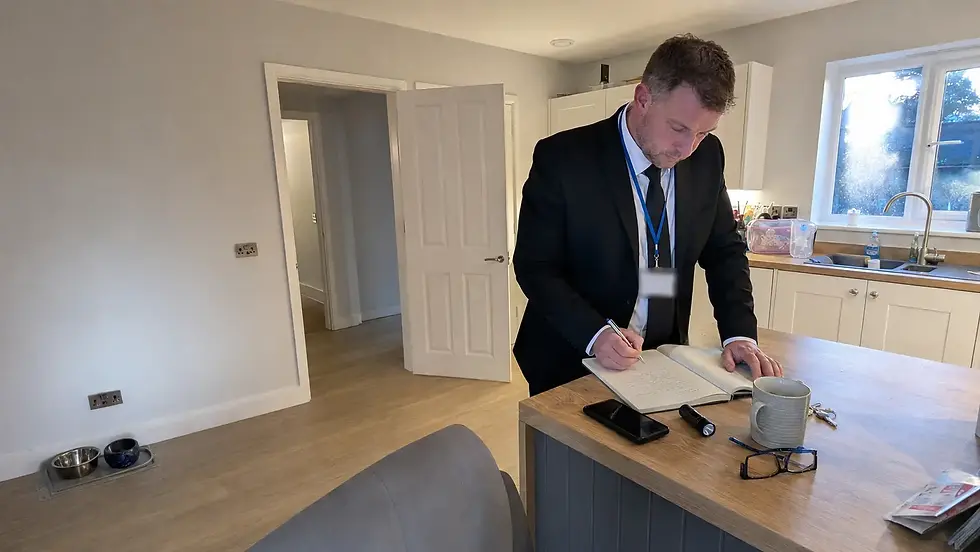
In practical terms, residential security guarding means manned guarding for a private residence, high-value building or estate. Officers manage access control, observe movement around the property, carry out patrol routines and report concerns through an agreed escalation route. An RST may be visible at an estate entrance or lower-profile at an internal control point, depending on the property and the routine around it.
SIA guidance treats manned guarding as guarding premises against unauthorised access or occupation, and guarding property against damage or theft. For a residence, premises can include exterior boundaries such as walls, fences and gates. Property can include valuables, equipment and vehicles.
That definition matters because the service is practical. Residential security officers are there to control access, protect the residence and keep the right people informed when something needs attention.
Map the work officers actually do
The value of residential security sits in routine work carried out consistently. A good residential security officer role is built around checking, recording and escalating, so the household or estate manager is not left guessing what happened on site.
Access checks: Officers confirm expected visitors, deliveries and contractor arrivals against the agreed routine. If a contractor arrives early, brings an extra person or asks for access outside the agreed area, the officer checks before allowing movement further into the property.
Patrols: Officers check entrances, boundaries, parked vehicles and vulnerable points at agreed intervals. Patrols give structure to observation, so the officer is looking for specific issues instead of simply walking the site.
CCTV and alarms: Officers monitor relevant systems where assigned and escalate alerts through the agreed route. CCTV monitoring works best when the officer knows which cameras matter and who should be told if something needs action.
Handovers: Officers record incidents, open issues and expected movements, so cover continues cleanly between shifts. A handover should explain what is still live, who is expected and which instructions have changed.
At Fahrenheit Security, we place heavy weight on communication, situational awareness and management oversight because residential security duties sit so close to private routines. The officer needs to know when to step in, when to ask a question and when to keep the service low-profile.
Home security officers also protect time. If a managing agent has to chase every visitor query or reconstruct every handover, the cover has failed at the basic management level.
Typical users share a specific risk profile
Different households arrive at the same point by different routes. An overseas owner may need vacant property security while a London home is unused. A family office may want greater control during works. An estate manager may need recurring cover because entrances, visitors and boundaries need daily attention.
That shared point is exposure. Residential security for high-value homes makes sense where the property, people using it or pattern of access creates a risk that needs active on-site management. In Central London and wider Greater London, we see that question most often around Mayfair, Knightsbridge, Belgravia, Marylebone and Westminster, where high-value homes often sit close to shared entrances, busy streets and regular contractor movement.
The Office for National Statistics said police recorded burglary, including residential and non-residential burglary, fell by 9% to 223,456 offences in England and Wales in the year ending March 2026. That supports a measured view. Residential security is proportionate risk control for specific circumstances, rather than a sign that every home needs guarding.
Permanent and overnight cover
Permanent or overnight cover suits residences where access management is part of normal operation. A private estate, mansion block or high-value home with regular visitors may need a consistent officer presence at a gatehouse, reception point or internal post.
In that setting, the team protects continuity as much as the property. Officers learn the approved routine, understand expected movements and keep daily records that a household manager or managing agent can rely on.
Temporary, event-linked and vacant-property cover
Shorter cover fits a different pattern. Travel, private events, works at the property, a vacant period or a specific spell of unwanted attention may justify residential security guarding for a defined period.
Useful residential security cover is shaped around the risk period, not assumed to be 24-hour by default. That single point saves a lot of poor planning, because the right question is how the property is exposed at a particular time.

Compare residential security with other options
Similar security terms solve different problems. The table below compares concierge, alarm response, key holding, mobile patrols, residential security guarding and close protection, so you can match the service to the risk.
Option | Best suited to |
|---|---|
Concierge or porterage | Front-of-house presence, resident assistance and routine building tasks |
Alarm response or key holding | Attending alerts or managing keys when an on-site officer is not required |
Mobile patrols | Periodic checks where continuous cover is not proportionate |
Residential security guarding | On-site access control, patrols, visitor checks, CCTV or alarm response and escalation |
Close protection | Guarding a person where the risk is directed at the individual |
Residential security guarding manages the residence as a protected site, not as a reception desk, alarm contract or personal escort. Mixed arrangements can still make sense. A private residence may use alarm response for one area, residential security officers for access control and close protection where a specific individual needs personal cover.
SIA guidance draws a line between security guarding and close protection licences. Close protection covers guarding people against physical assault or injury, and security guarding covers premises or property against damage, theft, unauthorised access or disorderly behaviour. Where an officer is assigned CCTV duties, we check the role against the correct licence, including public space surveillance where that activity is involved.
That licensing point is simple in practice. Duties need to match the officer’s role, especially when the assignment moves between residence-led protection and person-led protection.
Discretion and continuity decide suitability
Suitability comes down to how well the cover fits the residence’s routine. Discreet residential security means visitor logs are handled carefully, CCTV access is controlled, contractor movement is checked and private household patterns are treated as confidential operating information.
Privacy deserves proper planning, especially in London properties with shared entrances, mews streets or overlooking cameras. GOV.UK domestic CCTV guidance says UK GDPR and the Data Protection Act 2018 can apply if a domestic CCTV system captures images of people outside the boundary of the private domestic property, such as shared spaces or public areas. For a residential security provider, that means camera use, footage access and viewing rights need clear handling from the start.
Continuity is the other test. At Fahrenheit Security, we focus on experienced officers, clear communication and structured management oversight because a private residence cannot run on isolated shifts. Scheduling, supervision and handover quality decide whether the service stays consistent when routines change.
The common mistake is buying visibility and giving too little attention to the management behind it. The officer you see matters. The management you rarely see decides whether residential cover works.

Questions we get asked about residential security
Can a security guard work at a private house?
Yes, a security guard can work at a private house where the role is properly defined and the officer has the right licence for the duties assigned. The important point is to separate guarding the residence from close protection of a person, because those roles can require different licences.
Does residential security have to be uniformed?
Residential security can be visible or low-profile, depending on the property and the reason for cover. We look at what the presence needs to achieve, because a uniform can help at an estate entrance and a lower-profile approach can suit a private household routine.
Can officers work from a gatehouse or inside the property?
Yes, officers can work from a gatehouse, reception point or internal control point if the layout supports it. The post should give the officer control of the right access points without disrupting normal household or building movement.
How much household information does a provider need?
A provider needs enough information to check expected visitors, regular suppliers, contractor access and escalation routes. The aim is controlled access with minimum exposure of private routine.
Can residential security work alongside close protection?
Yes, residential security and close protection can sit together on the same assignment. Residential security looks after the site, while close protection focuses on a person when the risk is directed at the individual.


Comments