Should you have security present when dismissing an employee?

Do you need security for a dismissal meeting?
No. We arrange dismissal security only when a credible risk justifies it, such as aggression, unauthorised access, theft, disruption or public exposure. For most low-risk dismissals, a private meeting led by HR or management is enough. Higher-risk cases need planned support, placed discreetly and used in proportion.
Most mistakes start with the word “present”. Security present when dismissing an employee can mean an officer in the room, but it can also mean someone nearby, at reception, on a retail floor or ready to help after the meeting. Those choices carry very different meanings for the employee, your managers and anyone else on site.
A good plan protects people without turning the dismissal into a public incident. The security presence should match the risk, the building layout and the employee’s likely route out of the workplace. If the arrangement makes a manageable meeting feel punitive, the plan has already started badly.

The risk threshold for security presence
A routine performance dismissal in a private office rarely needs a security officer nearby. A conduct dismissal involving prior threats, public access or valuable stock belongs in a different risk category, especially where the employee knows the site and can move quickly through sensitive areas.
Security belongs where there is a credible operational risk, not where the employer simply wants the dismissal to feel more controlled. We look for evidence that safety, access, property or business continuity could be affected, then we plan the lowest sensible level of support around that risk.
Security may be justified where one or more of these indicators are present:
Previous aggression: The employee has made threats, used abusive language or behaved in a way that makes escalation foreseeable.
Sensitive access: The person can reach stock rooms, server areas, cash, keys, passes, client records or restricted parts of the building.
Public-facing risk: The meeting sits close to a reception desk, trading floor, client area or shared entrance.
Likely disruption: The dismissal could interrupt trading, disturb tenants, affect visitors or draw attention in a shared workplace.
Lone working: The managers handling the meeting would otherwise be isolated before, during or after the conversation.
HSE guidance treats work-related violence as abuse, threats or assault connected with work, and employers need to assess significant risks and put suitable controls in place. Trained security personnel are one possible control where the risk assessment supports that choice.
For dismissing an aggressive employee, the question is practical: what could go wrong between the meeting room and the point where the person has left the site? A short written risk assessment for dismissal gives you a better answer than instinct, and it leaves a clearer trail for why workplace dismissal security was arranged.
Why the room is rarely the best default
Security presence works on a scale. An officer inside the meeting is the most visible option, so we reserve it for situations where that level of presence is justified by the risk.
The table below compares each security arrangement with the best fit for that arrangement.
Security arrangement | Best fit |
|---|---|
No security | Low-risk dismissal in a private, controlled workplace where HR and management can handle the meeting safely. |
Nearby standby | A possible risk of aggression, refusal to leave or disruption, where support should be close without changing the tone of the meeting. |
Reception or front-of-house | Shared buildings, public entrances, visitor areas or sites where access control matters as much as the meeting itself. |
Discreet escort | A respectful departure where property handover, access passes or route control need quiet management. |
In-room presence | Higher-risk cases involving credible threats, serious disruption risk or a clear need for immediate intervention. |
The strongest plan is the least intrusive option that still controls the risk, not the most visible display of authority. In practice, that often means security standby for a termination meeting rather than an officer sitting beside HR from the start.
A discreet security arrangement also gives the meeting room back to the people who need to speak. HR can explain the decision, management can answer employment points, and the security officer stays focused on movement, access and safety around the meeting.
The split between HR control and security support
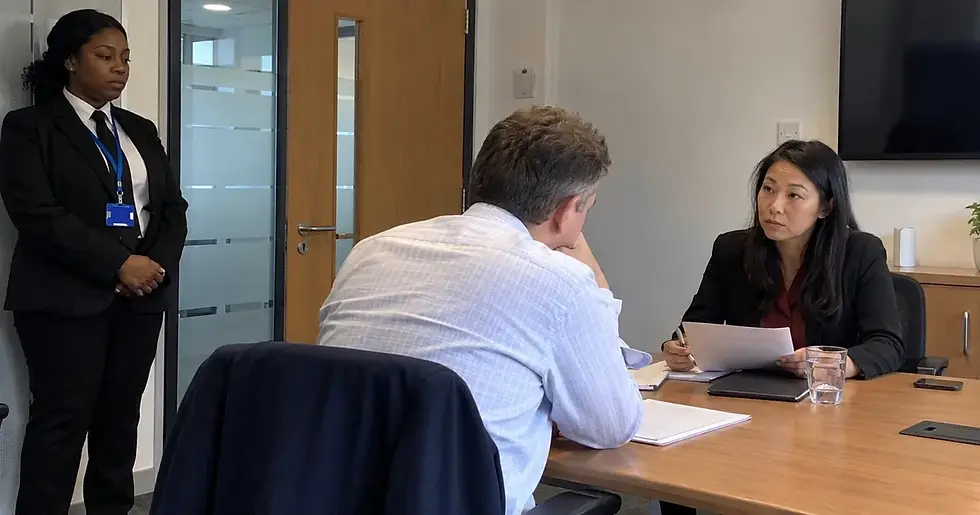
Imagine a dismissal meeting in a corporate office. HR leads the conversation, the manager explains the decision, and a security officer is positioned nearby with a clear brief on access, departure route and escalation. That arrangement keeps the dismissal process in the right hands while giving the site practical cover.
At Fahrenheit Security, we treat the security role in employee dismissal as support to an employer-led process. Our officers do not explain dismissal reasons, negotiate terms or answer questions about notice, appeal or pay. Those points belong with HR or management, because they control the decision and the process.
Acas says workers have a statutory right to be accompanied at certain disciplinary meetings, and the companion can be a fellow worker or trade union representative or official. That right still matters if security is arranged. A security presence should never make the employee feel that their companion, appeal route or opportunity to respond has been pushed aside.
Fair dismissal meeting security needs a tight brief. The officer needs to know where to stand, who to call, which areas are restricted and what behaviour should trigger support. They do not need unnecessary employment detail. The cleaner the split, the easier it is for HR and security during dismissal to stay calm and within their roles.

Professional security options for London workplaces
A Central London office with shared reception creates a different planning problem from a small private workplace. The employee may need to pass through lifts, a landlord-managed lobby, visitor barriers and a public pavement within minutes of the meeting ending.
Retail sites add another layer. A dismissal on or near a trading floor can affect customers, colleagues, stock rooms and cash areas. Wider Greater London premises can also involve mixed-use buildings where your meeting is private, but the departure route is shared with tenants, visitors or contractors.
For dismissal security in London, we start with the site layout as well as the person risk. Fahrenheit Security officers may be better placed near reception, at a staff entrance or along a controlled route than inside the meeting itself. In front-of-house and retail settings, presentation and restraint matter because the officer may be visible to people who have no connection with the dismissal.
Contracted security operatives in the UK may need an SIA licence where the work involves licensable guarding or protection activity. For security escort from a workplace, guarding premises against unauthorised access, guarding property against damage or theft, or protecting individuals from assault can all fall within that licensing framework.
Before hiring SIA licensed security guards for a dismissal, use the official SIA register to verify the licence. Appearance, uniform and verbal assurance are poor checks. A proper buying decision asks whether the operative is licensed for the work, briefed for the site and placed in a way that fits the risk.
Why automatic security can create the wrong problem
The common misconception is simple: security should be visible at every dismissal to show control. That sounds decisive, but it can create embarrassment, resentment and attention around a meeting that could have stayed private.
Low-risk dismissals need calm handling, clear communication and a process that respects the employee’s dignity. A visible guard at the door can make an ordinary HR meeting look like a confrontation before anyone has spoken. In those cases, the professional choice is careful planning by HR and management without unnecessary security theatre.
Higher-risk dismissals require a different judgement. If there has been a credible threat, a risk to valuable property or a real chance of disruption in a public area, skipping security can leave your managers exposed and your premises harder to control. The answer lies in matching the support to the risk in front of you.
The safest-looking option is not always the safest plan. Good termination meeting security keeps people protected, keeps the employer’s process in HR’s hands and leaves the employee with as much privacy as the situation allows.
Questions we get asked about dismissal security
Can we keep security nearby without telling the employee?
Yes, security can be planned as nearby standby where the risk justifies it and the officer has a clear role outside the room. The key point is proportionate support, because the employee does not need to see every safety measure for it to work.
Should a security officer wear uniform during a dismissal?
Uniform can help where visible access control is needed, such as reception or a retail entrance. Plain positioning may be more suitable where the main aim is discreet standby and a calm departure.
What should happen if the employee refuses to leave?
HR or management should keep the instruction clear and avoid turning the exchange into a debate. Security can help manage access, keep people safe and escalate if behaviour creates a real safety concern.
Can security collect company property from the employee?
Security can support property handover where that has been planned, especially with passes, keys or items linked to access control. HR or management should still decide what is being returned and keep the employment record accurate.
Does a security presence make a dismissal look unfair?
Security presence alone does not make a dismissal unfair, but poor handling can damage the process. Keep the meeting private, preserve any right to be accompanied, and use security for safety and access control only.


Comments