When your key staff don't show up: how retail security plugs the gap

Can retail security plug the gap when key staff do not show up?
Yes, retail security can plug the control gap when key people do not arrive, but it cannot replace a retail role. We use security cover to strengthen visible deterrence, queue control, floor observation and escalation while your store team keeps ownership of trading, supervision and customer service decisions.
A missing key person exposes a busy store fast. The risk does not always sit in the sales task itself. It sits at the entrance, in blind spots on the floor, at fitting rooms, near stock-risk areas and in the moments when a situation needs calm handling.
Current retail crime figures make that distinction matter. The British Retail Consortium Crime Report 2026 reported violence and abuse against shopworkers at 1,600 incidents a day, down from 2,000 but still far above the 455 incidents a day recorded in 2019 to 2020. Absence planning has become a risk-control issue, not just a rota problem.

The missing role is not the role security fills
A security officer protects the trading environment around your store team. Your retail managers and supervisors still make the commercial decisions, direct employees, handle tills and own the customer service operation.
Here is the practical boundary we use when a retailer asks about retail security cover for staff absence.
That boundary protects you as much as it protects the officer. If someone sells you temporary retail security guards as a direct substitute for a missing supervisor, the promise is wrong. The better question is whether the cover gives your remaining store team enough control to trade safely and keep decisions in the right hands.
The practical gap is control, visibility and escalation
A high-footfall store with one key person missing needs control at the pressure points first. If the entrance is busy, the floor has blind spots and the queue is building, a trained security officer gives the team a clearer operating line.
In Central London retail, that line matters because presentation and discipline sit side by side. A customer-facing officer cannot behave as though every shop floor is a warehouse gate. The officer needs to communicate clearly, hold position without blocking trade and know when a quiet verbal intervention is better than a heavy approach.
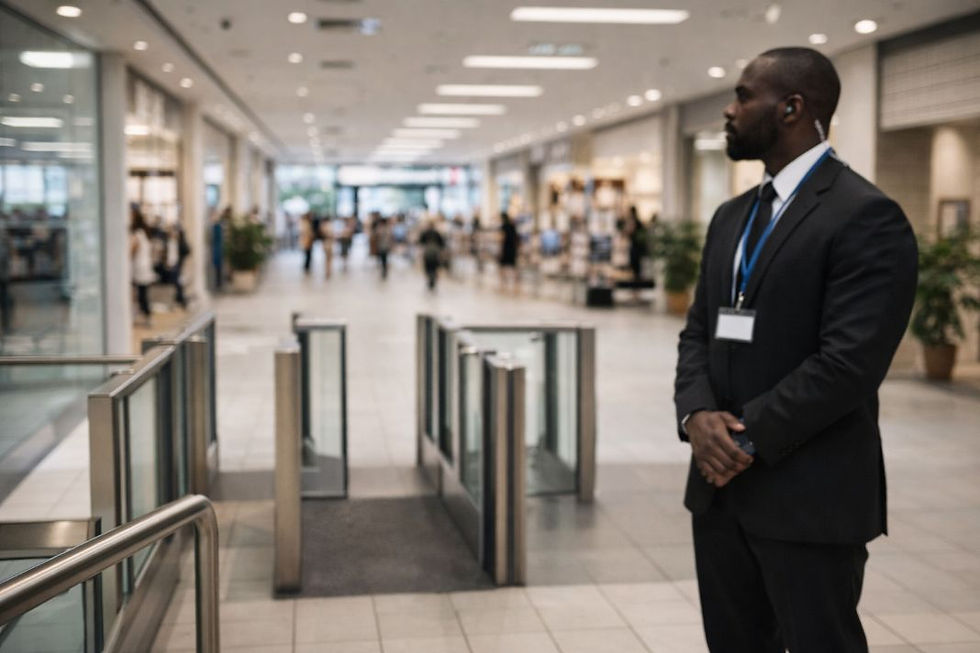
At Fahrenheit Security, we treat retail security guarding as a store continuity role with defined limits. The officer may be positioned at the entrance for visible deterrence, asked to walk the floor for loss prevention support or briefed on a known offender list if your business keeps one lawfully. Each placement has a reason.
Escalation is where weak cover fails. Watching someone behave oddly is one thing; recording it properly, telling the right person and knowing when to step back is another. For premium stores, flagship locations and major UK retail districts, the officer’s judgement matters as much as their presence.
Short-notice cover needs prepared instructions
Rapid cover is only as good as the handover. A security officer who arrives with no site contact, no assignment instructions and no escalation route starts the shift by guessing, which is exactly what you do not want during absence pressure.
We recommend keeping a short preparation pack for short-notice retail security cover. It does not need to read like a manual, but it needs enough detail for the officer to work safely and usefully.
Name the site contact. Give one person who can brief the officer and make decisions during the shift.
Set out the opening and closing procedure in plain words, including where the officer should stand and who has authority for keys or alarms.
Mark the risk areas. Identify the entrance, fitting rooms, stock-risk zones or any point where incidents have caused concern.
Explain the radio protocol, if radios are used, so the officer knows who to speak to and what language your store expects.
Give the escalation procedure for incidents, including when store management must be involved and how incident reporting is completed.
Share any known offender or exclusion information only if your business maintains it lawfully and the officer needs it for the assignment.
At Fahrenheit Security, we expect clear assignment information before short-notice cover is relied on. Management oversight then turns that brief into a workable deployment, including officer fit, position, reporting and follow-up if the shift changes.

Licence boundaries still shape the deployment
The officer, the task and the site have to match. Licensing is not paperwork after the event; it shapes what kind of security operative should attend and what they are being asked to do.
The Security Industry Authority, often shortened to SIA, says a licence is needed where work is part of a contract for services and involves licensable activity. For retail security guarding, the relevant point is usually guarding premises or property against theft, damage, unauthorised access or disorderly behaviour. A front line licence is the individual licence held by the person doing that work.
CCTV needs separate care. If an officer is monitoring people on camera for guarding or protection purposes, the SIA public space surveillance CCTV licence question may need checking. Stores with licensed premises issues may also need the SIA door supervisor licence question checked before anyone assumes ordinary guarding cover is enough.
We do not expect you to interpret the Private Security Industry Act 2001 or licensing categories in the middle of a rota gap. A professional retail security provider sets the role boundary before deployment, so the officer is briefed for the right activity and the store is not left improvising.
Planned cover beats a rota scramble
One approach is to wait until a key person fails to arrive, then ask for emergency retail security guards and hope the shift holds. Another approach is to treat retail security contingency as part of your continuity plan, with assignment instructions, a risk profile and an agreed escalation route already in place.
The second approach works better over time because it removes uncertainty before the pressure starts. Officer fit is clearer. Briefing is shorter. Reporting lands in the right place. Brand presentation is easier to maintain because the officer understands the store before the queue builds or an incident starts.
Short-notice cover still has its place. Sickness absence, transport disruption and no-shows do not always give warning. Planned retail security cover simply gives that emergency response a better base, so the store gets controlled continuity rather than a rushed presence at the door.

Questions we get asked about retail security cover
Can temporary retail security cover help if we are short on retail employees?
Yes, temporary security cover can help control risk while your retail team stays focused on trading. It works best when you use it for visibility, loss prevention support, incident response and escalation, rather than ordinary retail duties.
Should the officer stay at the entrance or walk the shop floor?
The best position depends on the pressure point in your store. Entrance presence suits queue pressure and access control, while floor walks suit observation and loss prevention support in stock-risk areas.
Can a security officer support opening and closing?
A security officer can support presence, observation and incident response around opening and closing. Your authorised retail team still owns keyholding, alarm authority and trading decisions.
What information should we give about repeat offenders?
You should share only information your business maintains lawfully and only where it is relevant to the assignment. The officer needs enough context to observe, report and escalate through the agreed procedure.
Can the same officer watch CCTV during the shift?
CCTV use needs to match the officer’s licence and the purpose of the monitoring. If camera work is part of the role, the licence position should be checked before deployment rather than assumed on the day.
This is general information, not professional advice.


Comments