Why do some London shops hire two security guards when one seems like enough?

Why would a London shop need two security guards instead of one?
Some London shops use two security guards because security needs are shaped by risk, layout, footfall and the type of incidents a store may face. One guard may be enough for a smaller, quieter site, but a busier or more exposed shop can need dual coverage so that deterrence, customer reassurance and incident response all happen at the same time.
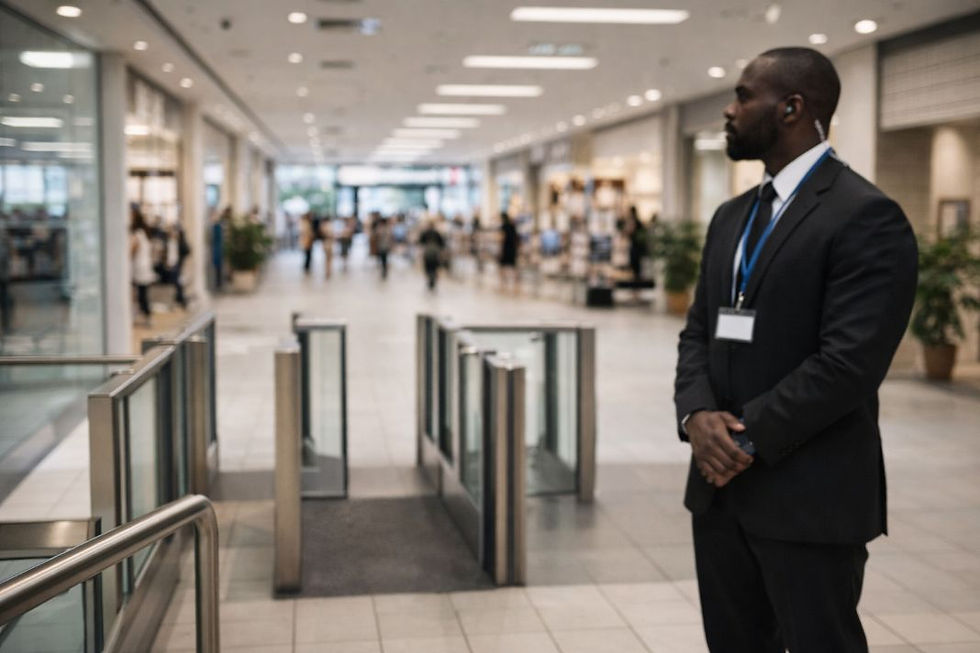
A familiar scene on a London high street is a guard by the entrance and another moving through the shop floor. At first glance, that can look excessive. In practice, it often reflects the difference between simply being seen and actually being able to manage a live retail environment.
Visible security affects behaviour. A single officer can deter some opportunistic theft, but two officers can change the overall atmosphere more effectively, especially in locations with heavy footfall, repeated shoplifting risk or a store profile that attracts attention. Public perception matters as well, because staff and customers often feel more settled when the security presence looks measured and purposeful.
Several factors sit behind that decision:
Two guards create a stronger visible security presence at entrances, exits and on the shop floor.
Dual coverage can reassure employees and customers during busy trading periods.
A pair of officers can respond more effectively if one area needs attention and another still needs watching.
Location also plays a part. Shops in central areas, near major transport links, or within districts supported by local business improvement districts often deal with very different trading conditions from a quieter neighbourhood branch. Metropolitan Police advice, local patterns of offending and day to day retail experience all feed into those choices.

Security staffing starts with risk, not guesswork
Why does one fashion shop have one guard while another nearby has two? The answer usually starts with a security risk assessment rather than a rough estimate.
Retailers and security consultancies look at the store's specific risk profile. That includes previous incidents, the nature of the stock, opening hours, known pressure points and how easy it would be for someone to enter, conceal items and leave. A compact shop with clear sightlines presents one set of issues. A larger store with premium goods and frequent crowding presents another.
A simple planning process often covers these points:
Review incident history, including theft, abusive behaviour and problem periods.
Assess the physical environment, such as entrances, exits, sightlines and vulnerable areas.
Match staffing levels to trading patterns, stock value and the likely need for a quick response.
Budget has a role, but it is rarely the only one. Retail management teams weigh cost against exposure, disruption and the practical need to keep the shop running smoothly. Crime statistics databases and local authority information can support those decisions, although the final staffing plan usually comes down to what happens in that specific store, on that specific trading pattern.
One shop may need two officers only at peak times, such as late afternoons, weekends or major sales periods. Another may need dual coverage throughout the day because the mix of merchandise, footfall and past incidents leaves little room for gaps.
Dual roles go far beyond standing at the door
A retail security guard is rarely limited to watching who comes in and out. In many London shops, the role includes observation, patrols, customer interaction, staff support and incident response, sometimes all within the same hour.
If one operative leaves the entrance to deal with a problem near the fitting rooms or self-checkout area, the front of house presence disappears. That gap matters. Shops often want a visible deterrent at the door and active awareness on the floor at the same time, which means that one person can quickly become stretched.
Daily duties can overlap in ways that make dual security coverage more practical:
One guard can remain visible at the entrance while the other patrols blind spots or high-risk departments.
One officer can speak with a distressed customer or support store colleagues while the other maintains general observation.
One operative can manage an incident, specifically a refusal to leave or suspected theft, while the second preserves order around the rest of the shop.
Customer service is part of the picture as well. Security officers in client-facing stores often give directions, note suspicious behaviour, support opening and closing routines and act as a calm presence when pressure rises. That combination of visibility and flexibility is difficult to sustain with only one person, especially in shops with busy floor plans or multiple service points.
Busy shops and awkward layouts change the equation
A crowded store can make even straightforward security tasks harder. Once shoppers fill the aisles, sightlines shorten, queues build and movement becomes less predictable.
Store design can add another layer. A shop with more than one entrance, split levels, recessed corners, fitting rooms or deep product bays creates blind spots that a solo operative cannot monitor continuously. Retail architects may focus on customer flow and display impact, but those same features can complicate store surveillance.
Picture a shop with a street entrance, an internal shopping centre entrance and a staircase leading to another floor. One guard at the front door cannot also monitor movement near the second exit or respond immediately upstairs. Two guards give the store a better spread of observation, particularly during peak periods when crowd dynamics shift from minute to minute.
Shopping centre management and crowd control guidance also influence deployment during promotional events, holiday trading and sale launches. In those settings, security is partly about theft prevention and partly about maintaining an orderly, comfortable environment for everyone using the space. A single officer may cope on a quiet Tuesday morning, yet struggle during a Saturday rush in the same building.
When something happens, teamwork matters
Incidents in shops are often small, fast-moving and disruptive rather than dramatic. A suspected theft, an aggressive refusal to leave, a vulnerable person needing support or a queue-side argument can all demand attention straight away.
With two guards, roles can be divided cleanly. One officer addresses the immediate issue. The other maintains wider awareness, supports shop colleagues, manages bystanders or helps preserve a safe route through the store. That shared response is one reason many retail security teams prefer paired coverage in busier settings.
A typical split during an incident may look like this:
One guard engages with the incident and communicates with store management.
The second guard watches exits, reassures customers and supports other members of the retail team.
If escalation is needed, the pair can coordinate with emergency services or follow the site's incident response protocols without leaving the wider shop exposed.
Communication improves as well. Two operatives can observe different angles, confirm what is happening and avoid the tunnel vision that can affect anyone dealing with pressure alone. The practical benefit is not simply strength in numbers. It is the ability to keep the shop functioning even when something unexpected interrupts normal trading.
Group offending changes the risk picture
Some shops face occasional opportunistic theft. Others also need to think about organised retail crime or small groups working together.
Group offending can involve distraction, coordinated movement or the use of separate roles inside the store. One person may occupy an employee, another may create confusion near an exit, and someone else may target stock. Police crime prevention units and national retail crime forums have long discussed the operational difficulty of dealing with coordinated behaviour in busy retail settings.
A solo operative has obvious limits in that situation. If one guard moves to challenge suspicious behaviour in one area, another part of the store can become vulnerable straight away. With two officers, visible teamwork can interrupt that rhythm before an incident develops fully.
That does not mean every London shop faces the same threat level. Many do not. Yet stores in prime shopping districts, high traffic locations or categories with easily resold goods may choose a stronger security deterrent because coordinated offending exploits distraction and speed, and both are common in retail.
The human side is easy to overlook
Staff wellbeing often sits quietly behind security staffing decisions. Busy shops place employees under pressure, especially during rush periods, confrontational moments or repeated low-level incidents that wear people down over time.
Two security guards can reduce that strain in practical ways. One officer may support a member of the retail team after an unpleasant interaction while the other keeps normal operations covered. A visible pair can also reassure newer employees, lone supervisors and customer-facing colleagues who need to focus on service without feeling isolated.
Customers notice the tone of a shop as much as its layout. A calm, professional retail security presence can make the environment feel more organised, especially for older shoppers, families, or anyone unsettled by crowding and tension. In a well-run store, security officers are part of the experience of order and reassurance, not a sign that something is wrong.
That is one reason providers such as Fahrenheit Security place value on communication and situational awareness in client-facing environments. Retail security works best when it supports the people in the building as well as the stock on the shelves.

"Enough" depends on what the shop actually needs
The idea that one guard should always be enough comes from what a passer-by can see in a few seconds. Security staffing decisions are made from a much wider view.
Retail security strategy has to account for timing, layout, incident history, store profile and the simple fact that one person can only be in one place at once. Two officers may look like a luxury from outside, yet inside the shop they may be covering separate entrances, balancing deterrence with customer reassurance, or making sure an incident does not pull the whole store off balance.
Professional security advice tends to avoid blanket rules for that reason. Some shops need one capable officer. Some need two at key periods. Others may need a different mix again as risks and trading patterns shift. The real measure is not how many guards look reasonable from the pavement, but whether the security presence matches the reality of the shop it serves.


Comments