Is it worth hiring a security guard for your London office over the summer when half the team is on holiday?

Is extra office security in London worth considering during the summer holiday period?
Yes, in many offices it is. Lower occupancy can reduce casual oversight, leave entrances and floors quieter for longer periods, and create gaps in access control, visitor handling, and after-hours response. Whether a security guard is worthwhile depends on the building, the level of footfall nearby, the value of equipment or data on site, and how well other security measures perform when fewer employees are around.
Summer often feels like a quieter season in office life, especially in London where annual leave can thin out whole departments at once. A calm office, though, is not always a low-risk office. Fewer people on site usually means fewer eyes on entrances, fewer people noticing unfamiliar movement, and less informal oversight of shared areas.
That matters in commercial districts where buildings stay active even when one tenant slows down. Delivery drivers still arrive, contractors still need access, and neighbouring offices may operate on very different schedules. Local business improvement districts, London borough councils, and Metropolitan Police communications often focus on practical crime prevention all year round because risk does not disappear with the holiday calendar.

Understanding summer security risks in London offices
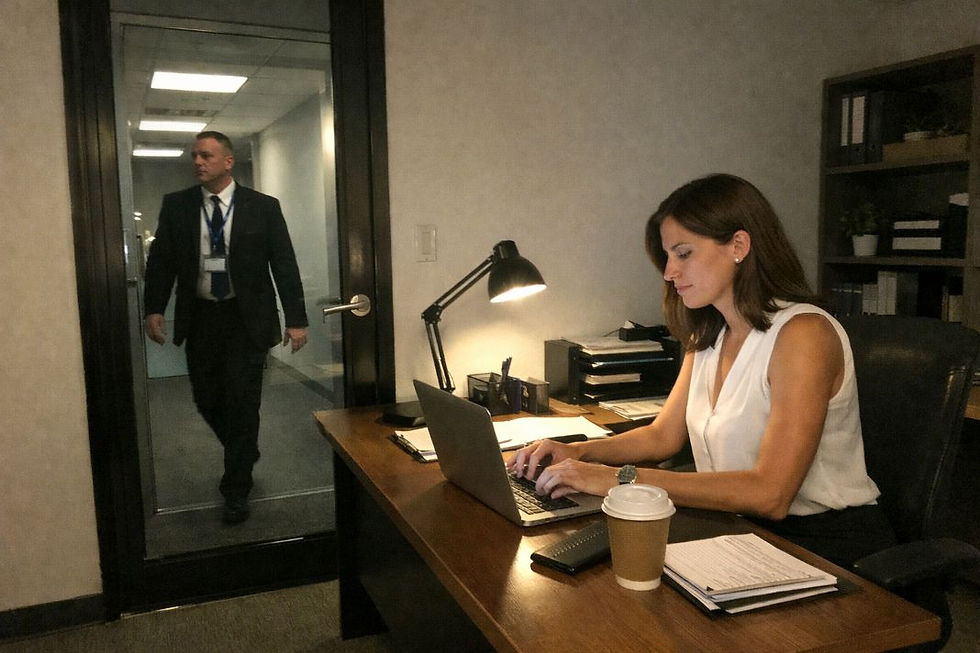
Reduced office occupancy changes how risk shows up. Opportunistic theft becomes easier when fewer people are around to challenge someone carrying equipment out of a side entrance. After-hours access can go unnoticed for longer if managers are away and floors are half empty the next morning.
A quiet period also creates a false sense of comfort. Decision-makers sometimes assume that an emptier office means less to protect, yet the opposite can be true if expensive laptops, meeting room screens, stock samples, keys, or records remain on site without the usual level of supervision.
Common pressure points in summer office security include:
reception areas with reduced cover during lunch breaks or annual leave
side doors or service entrances that are checked less often
shared buildings where vacant premises make unusual movement harder to spot
lone workers staying late in otherwise empty offices
contractors and visitors arriving when regular managers are absent
Visible security presence can change that picture quickly. Even one trained office security guard at the right hours can tighten access control, challenge unexpected visitors, log incidents properly, and keep building routines consistent during a period when normal habits slip.
Evaluating the value of security guards during low occupancy
A security officer does far more than stand by the door. In a low occupancy office, the role often shifts from general front-of-house support to active control of access, patrol routines, incident logging, and practical response if something looks wrong.
During summer, that flexibility matters. If reception is lightly staffed, a guard can manage visitors and deliveries. If a floor is almost empty, regular patrols can pick up unsecured meeting rooms, forced windows, or out-of-place activity. If someone is working late on their own, a visible professional presence also supports lone worker safety in a way that technology alone cannot fully match.
The difference between staffed and unstaffed cover often looks like this:
Staffed security cover: controlled entry, visible deterrence, on-site response, patrols, visitor verification, documented incidents
Unstaffed office with systems only: delayed response, reliance on cameras after the fact, greater pressure on managers, inconsistent checks during absences
Insurance providers and property management firms may also take a close interest in how access is managed during quieter periods, especially in multi-tenant buildings. The issue is rarely just theft. It can include unauthorised entry, damage, fire alarm response, welfare concerns, and the practical need for someone competent to make decisions on site.
For some offices, the value lies in deterrence. For others, it lies in having a trained person available when the building does not behave as expected on a Friday afternoon in August.
Cost considerations: is temporary security worth the investment?
Picture a central London office with patchy attendance across six summer weeks. Senior managers are away in rotation, reception cover is thinner than usual, and cleaning or maintenance visits continue as normal. On paper, adding temporary security may look like an extra line in the budget. In practice, the better comparison is between the cost of cover and the cost of an incident that drags on because nobody is there to catch it early.
Losses are not limited to stolen items. A single access issue can lead to lock changes, internal reviews, disruption to teams, time spent dealing with insurers, and reputational discomfort if clients or visitors are affected. Commercial insurers may cover some events, although cover terms, excesses, and exclusions vary, so security presence should never be treated as a simple insurance substitute.
A sensible cost review usually focuses on three points:
What is exposed during the holiday period, including equipment, confidential information, keys, and building access?
Which hours carry the most risk, such as early mornings, evenings, or days with minimal reception support?
Would a short-term security contract reduce enough operational pressure to justify the spend?
Flexible arrangements can make sense here. Some offices do not need full-day guarding for the entire summer. They may need an office security guard only at opening and closing times, during known low-cover dates, or for a short run while internal rotas are stretched. Fahrenheit Security is one of the providers operating in this space, where the shape of the cover matters as much as the number of hours.
Budgeting mistakes tend to happen when firms look only at the hourly rate and ignore the broader effect on operations. A cheaper choice that leaves gaps in incident response or access management can prove expensive in ways that do not appear on the original quote.
Practical alternatives to on-site security guards
Some offices will decide that a full-time on-site guard is unnecessary. That can be reasonable, provided the alternative measures are strong enough for the actual risk profile of the building.
Useful options include:
remote monitoring through CCTV monitoring centres
tighter access control rules for visitors, contractors, and out-of-hours entry
keyholder and alarm response arrangements
clearer staff briefings before peak holiday periods
closer coordination with building management companies in shared premises
Remote surveillance can be effective where camera coverage is good and alerts are monitored properly. Access control systems can restrict movement and create useful records. Staff briefings can reduce casual mistakes, including propped-open doors or unchallenged visitors. Building management can also provide useful support in multi-occupied properties where common entrances and loading areas are shared.
Even so, non-guard security has limits. Cameras record, but they do not physically intervene. Alarm response can be prompt, but it is still reactive. Access control systems can deny entry, yet they cannot assess body language, challenge a visitor in person, or notice that a contractor has wandered somewhere they should not be.
A layered approach often works best. Technology handles routine control and record-keeping, while human oversight fills the gaps that systems cannot interpret on their own.

What to consider before making a decision
Before choosing summer security cover, step back from the assumption that every office needs the same answer. A small serviced office with strong reception and managed access has different needs from a standalone headquarters with multiple entry points and irregular contractor visits.
A practical decision framework looks like this:
Review occupancy patterns for the exact weeks when annual leave is highest.
Check incident history, including near-misses, tailgating, missing items, or after-hours access issues.
Look at site layout, namely entrances, stairwells, loading areas, reception visibility, and vacant floors.
Speak with facilities managers, HR departments, and building management about pressure points during low cover.
Compare the current setup against what would happen if an incident occurred at 7 pm with only one employee still inside.
Contractual obligations may also shape the answer. Some leases, client requirements, or internal policies place expectations on access control, visitor handling, or emergency procedures. A formal risk assessment, whether completed internally or with specialist input, can turn a vague concern into a clear decision.
Cultural fit matters as well. In some offices, a customer-facing security officer can support the way the business wants to receive guests and manage its front-of-house presence. Elsewhere, a lower-profile arrangement may be more suitable if the main concern is after-hours cover and patrols.
Common misconceptions about office security in summer
Quiet offices are not automatically safe offices. That assumption is common, and it often leads businesses to scale back oversight at the very moment their usual checks are weakest.
Technology can also create overconfidence. CCTV, alarms, and access cards are useful, although they depend on maintenance, monitoring, and a clear response plan. If an alert comes through and nobody acts on it quickly, the existence of the system does not solve much on its own.
Insurance is another area where assumptions creep in. Insurance brokers and security consultancies often remind clients that cover may not erase operational disruption, internal workload, or the inconvenience of replacing equipment and reviewing procedures after an event.
Short-term cover is sometimes dismissed as excessive because the risk window seems brief. Yet many summer issues arise precisely because routines are temporarily altered. A month of weaker controls can be enough to expose a gap that would stay hidden during a normal period.
Human presence still has a distinct value. A trained security officer can notice context, challenge behaviour, reassure lone workers, and make judgement calls in real time, which is something property management associations and building operators continue to recognise in busy commercial settings.
Looking ahead: rethinking office security for future summers
The best summer security decisions usually improve the next one. Once a business has seen where annual leave strains reception, after-hours access, contractor management, or lone working arrangements, it can plan with more precision instead of reacting at the last minute.
Office use in London is also changing. Some teams work hybrid patterns all year, which means summer may simply intensify a lower-occupancy model that already exists. That makes regular review more useful than one-off fixes.
Future planning tends to work well when organisations keep a simple record of what happened, what nearly happened, and which controls held up under pressure. Facilities management bodies, industry forums, and security training providers all point in the same practical direction: review routines, update policies, and match security cover to how the building is genuinely used.
For many offices, the real question is less about whether summer is quiet and more about whether quiet periods leave the premises less supervised than the business can comfortably accept.


Comments