Why Flagship Stores Face Higher Risk Than Smaller Retail Units
- Fahrenheit Security

- Mar 9
- 4 min read
Why do flagship stores face greater risk than smaller retail units?
Flagship stores face greater risk because their size, visibility, and high levels of foot traffic make security harder to manage. Even with increased staffing and investment, the scale of these environments introduces blind spots that are less common in smaller, more contained spaces.

Bigger Spaces, Bigger Assumptions: Why Flagships Aren’t Automatically Safer
Many assume larger stores are safer. They have more staff, better technology, and greater visibility. However, beneath the surface, the picture is more complex.
As flagship stores grow, maintaining oversight becomes harder. More floor area, higher customer density, and multiple access points introduce retail security challenges. Despite the appearance of safety, the structure of these stores can weaken practical control.
Large retailers often assume that investment and brand presence reduce exposure. However, increased operational scale often leads to gaps in visibility, slower response, and diluted staff awareness. Risk adapts to scale and does not always respond to additional budget.
Scale and Footfall Change How People Behave in Flagship Stores
Customer behaviour shifts in larger, crowded environments. In a smaller shop, people feel observed and accountable. In a busy flagship store, the crowd provides anonymity.
This sense of being unnoticed can lead to:
Reduced personal accountability
Increased opportunistic behaviour
Less awareness of surroundings
Willingness to test boundaries or rules
Greater distraction and impulsivity
The more people there are, the harder it is for staff to monitor and assess intent.
Security coverage becomes stretched as foot traffic rises. Adding more officers alone is not enough. Attention span, situational awareness, and behavioural dilution all play a role. Staff may be present but are often unable to respond quickly due to physical and psychological barriers created by customer density.
These patterns are especially evident in large retail environments where high-footfall retail risk multiplies with operational scale. Understanding these shifts helps align retail security strategies more closely with real-world conditions.

When Visibility Becomes a Liability, Not a Strength
Flagship stores are built to attract attention. They are prominent, well-lit, and filled with valuable merchandise. However, visibility and predictability also introduce flagship store risk.
Criminal groups and opportunists tend to focus on what is most visible. Consistent routines and fixed layouts offer clues that make targeting easier. The repetition of open displays and high-value zones becomes part of an observable pattern.
This situation does not make visibility wrong, but it does require context. Predictable routines within high-profile stores make reconnaissance and targeting easier for those with intent.
Security strategies must take into account how visibility affects exposure. Recognising the double role of prominence as both asset and liability is key to flagship retail security planning. Environmental complexity adds further pressure, especially when visibility is paired with high-value merchandise in open zones.
Complex Layouts and Multiple Entrances Increase Blind Spots
Flagship stores use open-plan designs, multiple entrances, and large footprints to attract and accommodate customers. These same features create gaps in coverage.
In smaller shops, one or two entrances provide manageable visibility. In flagship environments, it becomes difficult to track movement consistently across all points.
Each additional access point complicates monitoring and challenges access control measures. Large distances between departments and multiple floors mean that teams cannot easily respond in real time. Line-of-sight interruptions and access sprawl lead to response delays and environmental control issues.
Technology helps but has limits. CCTV provides evidence rather than intervention. Blind spots remain an operational reality unless layouts are supported with strong positioning and well-coordinated teams. Understanding how retail layout security interacts with real-time movement is essential to identifying weak points and avoiding misplaced confidence in design alone.
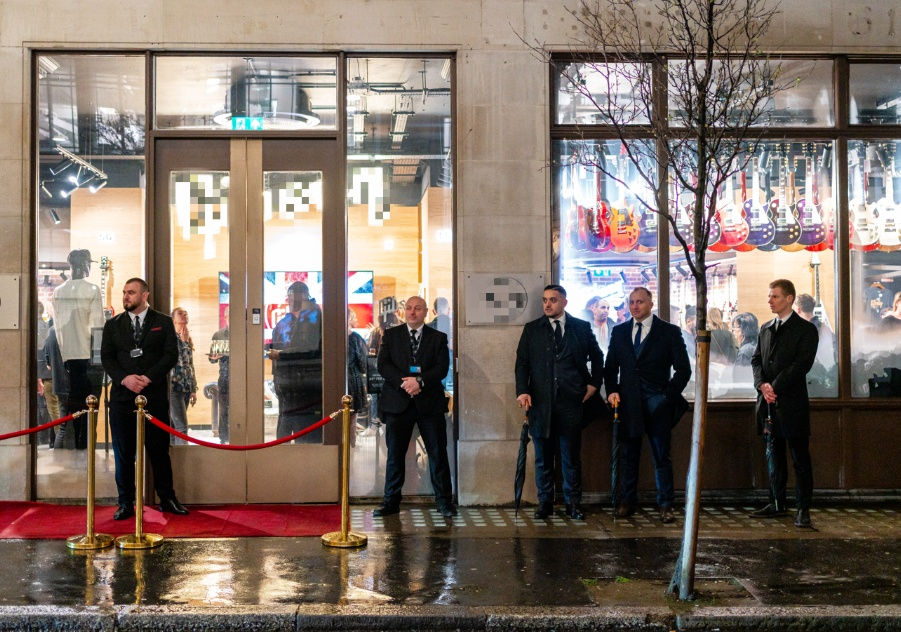
The Human Limits of Security and Store Teams in Large Spaces
Security personnel in flagship locations deal with sustained attention demands. Large, crowded stores create constant noise, frequent movement, and repeated minor disruptions.
This leads to attention fatigue. Over time, even the best-trained individuals experience slower reaction times and lower confidence when faced with ambiguous situations.
Hesitation during incidents is often caused by uncertainty rather than incompetence. Staff working in overstimulating environments deal with elevated stress and continuous low-level disruption. These conditions lead to morale erosion and escalation delay.
Retail staffing strategies need to account for these limitations. Supporting personnel with rotation schedules, clearer incident protocols, and adequate resources can make a measurable difference. Security officer awareness must be preserved over long shifts for effective store team response.
These challenges also affect loss prevention. Security officers who are mentally or physically fatigued are more likely to miss signs of opportunistic theft or targeted activity, especially in high-traffic areas.
Why Smaller Retail Units Retain Control More Easily
Small shops benefit from simpler layouts and direct oversight. Fewer people and entry points make real-time awareness easier.
The presence of a manager or experienced staff member adds informal surveillance. Behavioural changes are easier to spot, and intervention happens quickly. Unusual activity triggers a faster and more confident response.
There is also social accountability. In a familiar setting, customers are more likely to act appropriately. Misconduct is noticed, remembered, and responded to without delay.
While no environment is risk-free, small retail formats offer natural control advantages. Their size and simplicity allow for tighter operational boundaries. Independent shop security thrives on proximity, familiarity, and immediate recognition.
What This Means for Understanding Risk in Flagship Retail
Risk in flagship retail is not a failure of security teams. It is a function of design. Larger spaces, higher visibility, and increased footfall change how control is maintained. Perfect prevention is not always possible. However, recognising how flagship store design increases operational complexity allows for better strategic planning. Expectations can shift from unrealistic guarantees to practical resilience.
Fahrenheit Security provides experienced officers for high-risk, high-visibility environments. Their teams understand flagship retail risk management and help bridge the gap between layout and response through presence, situational insight, and frontline awareness.
Operational realism is key. Leaders who understand the structural nature of retail risk make calmer decisions and build stronger, more sustainable strategies. Framing these challenges through the lens of risk mitigation helps align internal expectations and guide investments more effectively.


Comments